
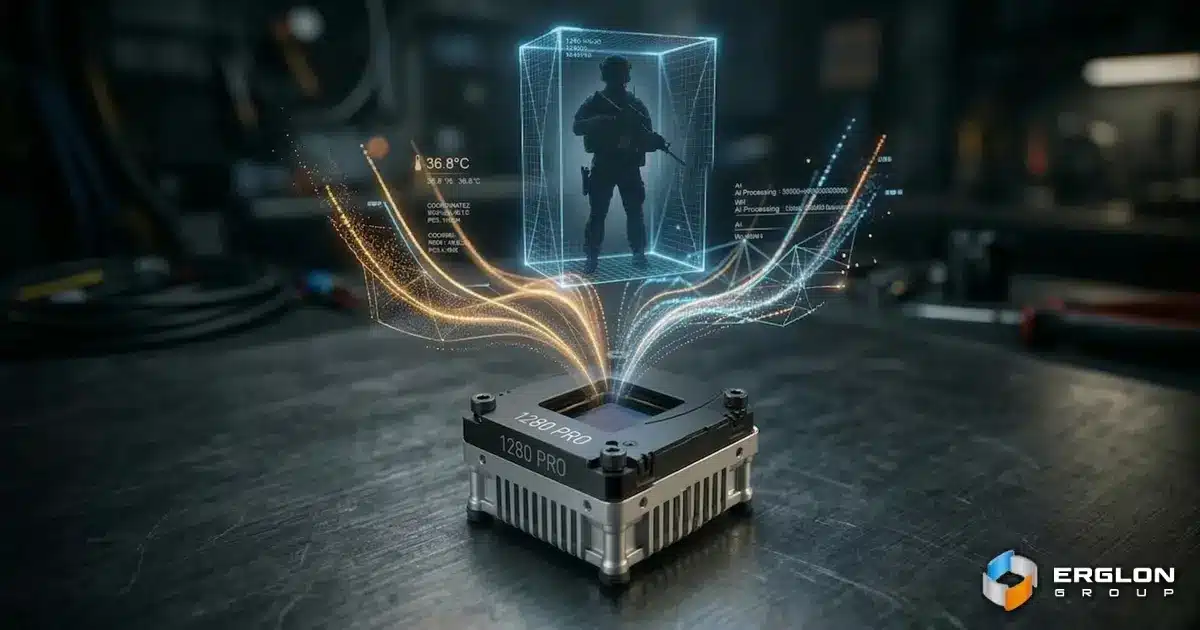
Over the past decade, thermal imaging technology has entered widespread use. Today, achieving tactical dominance is no longer simply about being the first to detect a threat, but being the first to understand it under pressure within degraded operational environments. This paper examines the evolution of compact thermal cores, transitioning from traditional 320 and 640 architectures to modern 1024 and 1280 PRO imaging platforms. It illustrates how sensor miniaturization combined with advanced multi-spectrum processing allows superior image quality within footprints as small as 21 × 21 mm. By incorporating AI-assisted target recognition directly at the edge, modern thermal systems deliver real-time object classification alongside situational alerts, lowering operator workload and processing latency during mission-critical events. Furthermore, we explore fusing IIC, LWIR, SWIR, and visible bands to maximize environmental adaptability, refine range discrimination, and boost operational safety in low-visibility conditions. Additionally, we analyze advances in low-power thermal vision designed for dismounted personnel, UAVs, and autonomous ground systems, highlighting new strategies for energy-efficient hardware and thermal-noise optimization. Together, these innovations define the next era of multi-sensor tactical imaging platforms—portable, intelligent, and continuously networked—empowering defense and law-enforcement experts to “see beyond” classic visual limits.
Before analyzing the technology, we must address operational reality. Technology yields value only when it responds directly to operational needs. The reality is that modern tactical settings have fundamentally transformed.
First — visibility conditions. Complete darkness is no longer an anomaly; it is the default operational baseline. Combined with heavy smoke, dense fog, dust, and complex urban infrastructure, modern environments are obscured, multi-layered, and visually challenging. Operators rarely work in clean, ideal scenarios. They execute missions in degraded visual environments by default.


Second — engagement speed. The timeframe between initial detection and action has shrunk significantly. Whether conducting urban engagements, border security, or UAV-driven ISR, threats surface and vanish rapidly. The window available to detect, identify, decide, and react is continuously narrowing. Milliseconds add up, and hesitation increases exposure. Slow visual interpretation is no longer tolerable.
Third — cognitive load. Operators today must handle multiple sensor feeds, communications streams, and threat channels, all while reconciling this incoming data in real time. Toggling between thermal and visible feeds, interpreting unclear thermal signatures, and managing radio channels creates massive cognitive overload. This overload impairs accuracy and accelerates fatigue—and fatigue breeds critical mistakes.
Fourth — multi-domain threats. Operational threats are no longer restricted to a single domain. Air vectors involve drones and aerial ISR; land vectors include vehicles and foot personnel; urban zones present dense civilian structures and infrastructure. Modern tactical solutions must function effortlessly across all domains, which demands integrated perception rather than isolated sensing elements.
And finally — compressed decision timelines. Initial detection used to be the main objective. Today, detection is merely step one. Target identification, classification, and threat prioritization must occur almost simultaneously. If a system only displays imagery, the analytical burden falls entirely on the operator. When the system aids in visual interpretation, decision-making time shortens instantly. That single distinction determines operational advantage.
The tactical domain has evolved much faster than sensor architectures have progressed. Legacy solutions were built for detection; modern operations require actionable intelligence. This is why compact cores, embedded fusion, and edge-assisted AI are not luxury features—they are mandatory adaptations. As the operational environment changes, our sensing hardware must evolve alongside it. That evolution is what we will examine next.
Before highlighting current innovations, we must acknowledge our technological baseline. Thermal imaging revolutionized night operations decades ago by allowing forces to observe what was previously hidden. However, that original framework was engineered for a different era, and it comes with structural limits:
- First — size and power. Traditional thermal systems were bulky, heavy, and power-hungry. They depended on high-power FPGAs, discrete circuit boards, and heavy cooling setups. They functioned, but were not optimized for modern, mobility-focused missions. When mounting equipment on drones, helmets, or lightweight weapons, mass and power consumption become strict limits.
- Second — isolation. Legacy thermal tools operated as standalone units. You used a thermal sight, a separate visible camera, and distinct communication gear. Operators had to mentally synthesize information across multiple devices. System integration happened inside the human brain, not inside the hardware.
- Third — interpretation was entirely human-driven. The sensor displayed heat signatures, leaving the operator to decide if a signature was a threat, a vehicle, a civilian, or a reflection. The sensor detected; the human interpreted. While functional, it imposed an immense cognitive burden on the operator.
- Fourth — delay. Because systems were heavy, compute-heavy, and unintegrated, latency bottlenecks emerged. Small delays compound rapidly—switching display views, analyzing ambiguous shapes, and reconciling feeds. Those extra seconds are critical during high-stakes engagements.
- Fifth — architecture. Early devices relied heavily on FPGA-based execution chains. FPGAs are powerful, but often inefficient for dynamic, AI-centric workloads. They consume excess power, increase physical footprints, and limit design flexibility. Modern demands require heterogeneous compute—optimized SoCs, dedicated AI accelerators, and edge-native intelligence.
- And finally — detection without context. Legacy thermal units answered one question well: Is something warm? Modern missions require deeper context: What is it? What is it doing? Is it relevant? Is it a threat? Simple detection is no longer sufficient; context is everything.
The traditional thermal framework was groundbreaking in its time, but it was centered solely on detection. Today’s missions demand interpretation, deep integration, and intelligence. That is the exact transition we are making: moving from thermal as a viewing tool to thermal as an intelligent perception system.
This transition marks one of the most vital engineering milestones in modern thermal imaging: resolution scaling without footprint expansion. Historically, raising resolution meant increasing device size, power draw, and structural complexity. That tradeoff no longer applies.
From 320 → 640 → 1280 and Beyond. We have advanced from 320 VGA cores to 640, to 1280, and are now pushing toward 1440-class output—all built inside compact core footprints. Crucially, we did not double the enclosure dimensions, the power draw, or the overall weight. That represents a fundamental structural shift in optical engineering.
Let’s look at the physics. Traditional thermal cores commonly utilized a 17-micron pixel pitch. The industry then moved to 12 microns, and we are now seeing 8.5-micron technology emerge. A smaller pixel pitch yields:
- Higher pixel density per unit area.
- Higher spatial resolution.
- Enhanced target discrimination—all within similar detector dimensions.
It is not just about adding pixels; it is about delivering higher intelligence per square millimeter.
Higher Resolution → Greater Pixel Density → Extended Identification Range
Higher resolution translates directly into a broader identification range. While long-distance detection can occur with fewer pixels, positive identification demands high pixel density on the target. The more pixels covering a human silhouette or vehicle frame, the higher the classification confidence. Higher resolution effectively bridges the gap between detection and identification.
Digital zoom used to be a major limitation. Zooming in on a 320 core caused image clarity to collapse. With 1280-class sensors, digital zoom becomes genuinely usable because visual structural integrity is preserved. This minimizes dependency on optical zoom assemblies, which are heavier and mechanically complex.
Same footprint — higher intelligence. This means no weight penalty for dismounted soldiers, no payload penalty for UAVs, and no enclosure redesign requirements for OEM hardware platforms. Instead, you extract far more actionable data from the exact same physical volume.
This is a structural scaling shift. We are packing greater perception capacity into smaller, more power-efficient modules. When combining high resolution with embedded fusion, Edge AI, and secure networking, you do not just refine image clarity—you expand operational effectiveness. Resolution scaling is not merely about crisp pictures; it is about extending identification ranges, maintaining zoom clarity, and providing richer intelligence without adding hardware bulk.
What matters next is the architectural shift that made this progression possible. We did not simply refine sensors; we completely restructured the core.
Early thermal setups were monolithic. The sensor, image processing board, FPGA pipeline, and communication modules were all separate, custom-built, and rigid. Every new hardware platform required a complete redesign, and scaling performance meant stacking hardware layers—which increased size, weight, and power (SWaP).
Today, system architecture looks vastly different. We now unify:
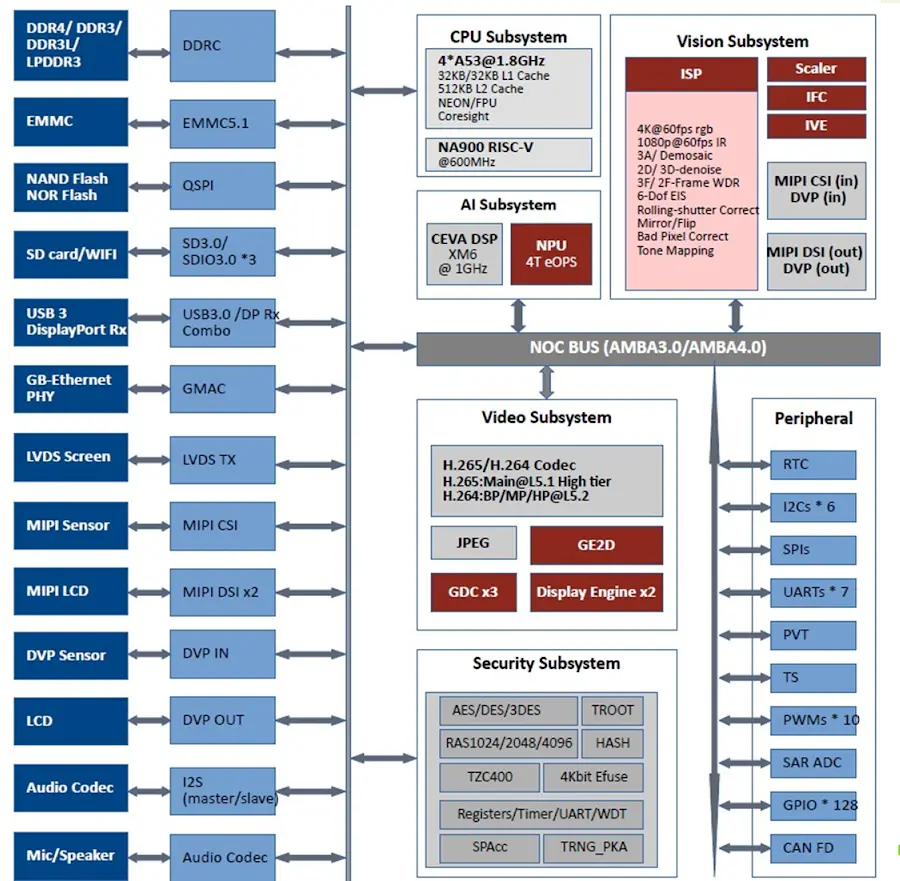
- The primary sensor, Image Signal Processor (ISP), and core processing subsystem.
- AI acceleration units and hardware security modules.
All of these are integrated inside a single compact core. Instead of managing distributed sub-boards, we utilize cohesive compute platforms. This cuts latency, simplifies system integration, and improves overall reliability.
Standardization represents a major operational breakthrough. Supporting standard interfaces—such as MIPI CSI, DVP, LVDS, USB, and Ethernet—allows the thermal core to connect directly into weapon sights, UAV gimbals, vehicle systems, or fixed surveillance nodes without re-engineering the processing chain. The core operates as a modular component rather than a custom sub-assembly.
This enables platform-agnostic deployment. The exact same compact core can be deployed on a drone, an infantry rifle, a ground robot, or a stationary security tower, because compute and vision processing are self-contained. The hosting platform becomes secondary; the core carries the system intelligence.
Rapid integration provides a major strategic edge. When OEMs and integrators deploy a compact thermal core without redesigning their system hardware, development timelines shrink, deployment accelerates, and upgrade paths simplify. Firmware and AI enhancements can be pushed across multiple product lines simultaneously.
+-----------------------------------------------------------------------+
|                         COMPACT THERMAL CORE                          |
|  +------------------+  +-------------------+  +--------------------+  |
|  |  CPU Cluster     |  |  AI Accelerators  |  |  ISP Chain         |  |
|  +------------------+  +-------------------+  +--------------------+  |
|  +------------------+  +-------------------+  +--------------------+  |
|  |  Video Codecs    |  |  Security Modules |  | Standard Interfaces|  |
|  +------------------+  +-------------------+  +--------------------+  |
+-----------------------------------------------------------------------+
As shown above, this is not merely a sensor module—it is a complete perception computer.
Transitioning from monolithic to modular setups enables resolution scaling, embedded multi-spectrum fusion, Edge AI, and secure networking without enlarging system dimensions. The compact thermal core serves as the foundation for modern intelligent vision platforms. Thermal cores are no longer simple optical components; they are modular intelligence engines designed for deployment anywhere and adaptation everywhere.
When discussing system capabilities, most people focus on resolution, AI analytics, fusion, and maximum range. However, in real missions, power draw is often the core constraint. Power is not just a specification on a datasheet—power is a tactical boundary.
I intentionally state: Power is a weapon. Energy management dictates mission duration, and duration defines tactical advantage.
- For dismounted infantry, battery weight is a real physical burden. Every additional watt requires carrying extra batteries, increasing total weight and soldier fatigue. Inefficient thermal gear shortens operational range. Energy-efficient cores extend mission timelines without increasing carry load—which directly impacts survivability.
- For UAV platforms, flight endurance is everything. Every watt drawn by payload sensors reduces loiter time, ISR persistence, and mission coverage. When thermal cores draw minimal power and execute processing at the edge, aircraft remain airborne longer. Extended flight times yield more intelligence gathered and greater operational impact.
- For persistent surveillance setups—such as border towers, remote stations, and perimeter security—systems run continuously on solar panels or battery banks. Inefficient hardware shortens uptime and demands frequent maintenance. Energy-efficient cores enable continuous monitoring with minimal field interventions.
The solution is smart power management, not performance reduction. By leveraging adaptive frame-rate control, dynamic power scaling, and demand-driven compute, frame rates can drop when motion is minimal and scale up instantly upon threat detection. Smart control preserves energy without sacrificing combat readiness.
The future of tactical optics focuses heavily on performance per watt. The most capable camera is useless if it cannot sustain operation in the field. Energy efficiency is a fundamental mission requirement. Power does not merely run hardware—it defines endurance, and endurance dictates tactical advantage.
Everything covered so far—compact cores, elevated resolution, multi-spectrum fusion, and energy efficiency—leads to a core premise: Pixels are not intelligent. Pixels are raw data, and raw data alone does not win engagements—intelligence does.
We have entered an era where imaging hardware must not only display scenes, but actively interpret them. That interpretation must take place at the edge—directly inside the sensor hardware.
First — operator workload. Operators continuously monitor multiple feeds. Thermal images require constant mental interpretation: Is that a threat? Is it moving? Is it relevant? Edge AI reduces this cognitive strain by executing automated object detection, human classification, vehicle identification, and anomaly detection. Instead of manually scanning every pixel, the operator receives prioritized alerts.
Second — speed. Human reaction speed has limits, whereas Edge AI processes data continuously. It identifies signatures and patterns faster than manual inspection, shrinking the time gap between Detection, Classification, and Decision. Milliseconds saved in processing become critical seconds saved during engagements.
Third — resilience. Cloud-dependent AI is unreliable in tactical zones due to constrained bandwidth, active jamming, and network disruption. If intelligence relies on cloud connectivity, intelligence drops out when connections fail. Edge AI ensures detection, classification, and threat prioritization continue uninterrupted in denied or degraded environments.
Cloud reliance introduces latency and vulnerability. Streaming high-resolution thermal or multi-spectrum streams to offsite servers consumes heavy bandwidth and increases response lag. Processing data locally at the edge eliminates round-trip delays, keeping data and decision-making local for complete operational autonomy.
This represents the shift from pixels to intelligence. The imaging core has transformed from a passive sensor into an active perception engine. It detects, classifies, prioritizes, and executes in real time. Combining edge AI with multi-spectrum fusion, higher resolution, and embedded processing yields systems that do not merely view targets—they understand them in context. The outcome includes reduced operator exhaustion, accelerated response times, higher-confidence decisions, and enhanced survivability. This is not automation replacing operators; it is technological augmentation multiplying human performance.
In modern operations, tactical intelligence cannot wait for the cloud—it must reside at the edge. Edge AI is no longer an optional feature; it is foundational architecture.
While marketing noise around AI is common, what does AI actually accomplish in thermal imaging under real operational pressure? It delivers four capabilities that directly alter outcomes:
+-----------------------------------------------------------------+
|                       EDGE AI CAPABILITIES                      |
|                                                                 |
|  [ Classification ]  --->  Identifies: Person / Vehicle / etc. |
|  [ Prioritization ]  --->  Ranks threats by speed & trajectory  |
|  [ Context Awareness ]---> Applies geofencing & time rules      |
|  [ False Positive ]  --->  Filters HVAC, roofs, & animals       |
+-----------------------------------------------------------------+
- Classification: Thermal sensors present heat signatures where a blob appears simply as a blob. AI converts that thermal signature into an identified category: Person, Vehicle, Animal, or Unknown Object. This dramatically speeds up identification. Operators no longer wonder what they are viewing—the system informs them instantly and consistently, regardless of stress, fatigue, or visual noise.
- Prioritization: Not all detections carry equal weight. AI models continuously evaluate movement direction, speed, trajectory changes, and behavioral anomalies. A stationary, warm vehicle is low priority; a moving vehicle heading toward a restricted zone is high priority. AI ranks threats in real time, turning thermal imaging into a tactical filter.
- Context Awareness: Intelligence goes beyond basic detection. A person walking down a city street at 2 PM is routine; a person running across a perimeter fence at 2 AM represents a different scenario. Edge AI integrates geofencing, time parameters, behavioral profiles, and sensor-fusion data to issue meaningful alerts rather than constant alarms.
- False Positive Reduction: Thermal hardware naturally reacts to heat—hot roofs, exhaust vents, industrial systems, and animals. AI learns movement dynamics and structural shapes, suppressing nuisance alarms. False positives erode user trust; once operators lose confidence in system alerts, the technology fails strategically.
In active deployments, combining classification, prioritization, context awareness, and false-positive filtering suppresses cognitive overload—one of the most underestimated operational risks today. This yields faster recognition, cleaner decision pathways, lower fatigue, and higher confidence. AI does not replace human operators; it augments human perception.
AI in thermal optics is not about visual overlays—it is about decision acceleration. The real value is not the bounding box on screen, but the reduced time between initial detection and complete understanding. We are transitioning from sensor-centric systems to decision-centric systems. Thermal cameras capture heat; modern perception systems extract meaning. In the field, embedded AI is not just a feature—it is a force multiplier. When executed securely at the edge in real time, it provides a clear operational advantage.
Analyzing different visual feeds of the same scene—such as a thermal view, a visible-spectrum view, and a processed high-contrast rendering—reveals that each tells a different part of the story, but none tells the whole story alone:
- Thermal Crossover: At dawn and dusk, when ambient environmental temperatures balance object heat signatures, thermal contrast collapses. Buildings, roads, and vehicles merge together visual details. During these transitions, thermal detection reliability drops—not because hardware failed, but because environmental physics shifted. Systems relying solely on LWIR contrast enter a degraded state.
- Texture Details: Thermal images capture temperature gradients rather than surface material details. You can spot a human shape, but evaluating equipment, posture, or subtle behavioral cues is difficult. Edge texture resolution in thermal bands is limited compared to visible or shortwave infrared wavelengths. For positive identification, contextual texture is vital, and thermal alone cannot supply it.
- Spectral Ambiguity: Heat signatures do not inherently signify threats. A hot vehicle exhaust, a warm roof, or reflected thermal energy can mislead operators. Without multi-spectral cross-confirmation, operators must manually interpret unclear shapes under high stress, increasing cognitive fatigue and error rates.
Relying on a single waveband creates clear blind spots because reality is environmentally complex. No single optical band solves every variable. LWIR excels at long-range detection; SWIR provides atmospheric penetration and material differentiation; Visible light delivers clear identification and visual context. Combining them suppresses ambiguity, boosts decision confidence, and speeds reaction times. Thermal optics revolutionized night operations; multi-spectrum intelligence will define the next decade of tactical dominance.
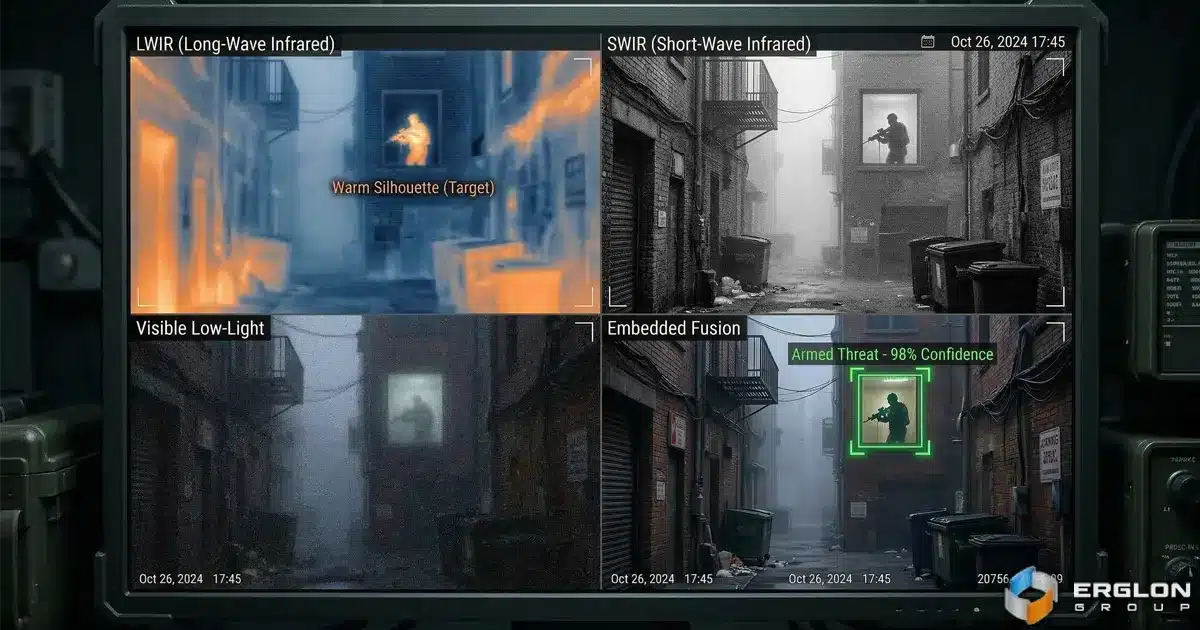
Analyzing the same scene across separate wavebands illustrates how each spectral band solves a specific operational challenge:
- LWIR (Long-Wave Infrared): The primary detection engine. It operates in total darkness by sensing heat signatures independent of visible light, spotting warm targets against cooler backgrounds.
- SWIR (Short-Wave Infrared): Penetrates atmospheric obscurants like fog, smoke, and haze far better than visible light. It sees through glass and highlights material contrasts that LWIR cannot register. Where thermal sees heat, SWIR exposes surface structure.
- Visible Spectrum: Delivers natural color, sharp texture, and environmental context where identification occurs—distinguishing friend from foe, identifying equipment types, and reading behavioral cues.
LWIR (Detection) + SWIR (Penetration) + Visible (Identification)
  ==> Fused Real-Time Perception Layer
When these three channels are fused at the pixel level—rather than displayed side-by-side—ambiguity drops, false positives decrease, and confidence increases. Operators no longer need to switch between separate feeds or mentally reconcile images; the system delivers a single, unified perception layer.
Whether deployed with dismounted soldiers in urban zones, aboard an ISR drone, or in perimeter surveillance across mixed terrain, multi-spectrum fusion ensures targets remain visible. When one spectrum degrades, another compensates dynamically:
- During thermal crossover, SWIR and visible feeds sustain contrast.
- In heavy smoke or haze, SWIR maintains vision.
- In zero ambient light, LWIR provides core sensing.
This core integration delivers higher-confidence decisions. In tactical engagements, confidence equals speed, speed eliminates hesitation, and eliminating hesitation improves survivability. Multi-spectrum fusion improves operational outcomes by unifying detection, penetration, and identification into a single perception engine.
Having addressed multi-spectrum fusion conceptually, we must evaluate where fusion processing occurs—because execution location determines whether fusion functions as a simple feature or a core capability.
Overlay vs. Embedded Fusion: Many current platforms execute fusion externally by capturing separate LWIR, SWIR, and visible streams, processing them independently, and overlaying them at the display level. While functional, this method adds latency, increases power draw, and introduces hardware complexity. True core-level fusion is embedded, native, and fully integrated.
- Pixel-Level Alignment: Core-level fusion requires exact pixel-to-pixel synchronization rather than simple image overlay. When sensors are geometrically calibrated within the core, every photon across all spectrums maps to the exact same spatial coordinate. This removes parallax errors, image ghosting, and visual misregistration during movement—vital for UAVs and ground vehicles.
- Minimal Latency: External processing pipelines accumulate latency over multiple stages. Native embedded fusion cuts processing overhead and eliminates redundant data transfers, yielding near-zero perceptible delay. Operators view a unified scene in real time rather than a stitched composite.
- SWaP Efficiency: External fusion requires standalone processors, extra memory modules, additional cabling, and thermal management. Embedding fusion inside the core architecture removes hardware layers, yielding smaller, lighter systems where every gram matters for soldiers and drones.
- Power Savings: External compute stages draw extra energy. Core-integrated fusion reduces redundant processing and bus traffic, cutting power consumption. Lower power draw extends UAV flight times, lengthens dismounted mission duration, and lowers the thermal signature of the device itself. Energy efficiency directly affects survivability.
An overlay is a simple visual aid; embedded fusion is an operational capability. Fusing streams at the core level unifies data streams in real time, allowing AI models to execute across a complete perception layer.
Operational Scenario: During a night urban patrol, thermal sensors detect targets ahead, SWIR cuts through lingering haze, and the visible channel provides structural context. With core-fused processing, the operator views one clear scene with no manual feed switching, no mental synthesis, and zero delay. Display overlays enhance pictures; core-level fusion expands capability—and capability defines next-generation tactical systems.
Innovation carries real value only when it directly improves field operations. The core benefits of integrated multi-spectrum perception apply across four major deployment scenarios:
- Dismounted Infantry: Situational awareness equals survival. In urban corridors, heavy woods, or low-visibility terrain, real-time detection, identification, and classification reduce hesitation. Compact, low-power multi-spectral cores supply thermal detection in dark zones, SWIR penetration through haze, and visible context under mixed lighting—reducing blind spots, device-switching delays, and physical operator fatigue.
- Unmanned Systems (UAS/UAV): Unmanned systems are transforming ISR and tactical operations, but payload dimensions, weight, and power draw remain strict limits. Core-embedded fusion enables smaller payloads, lower power draw, extended flight times, and real-time multi-spectral intelligence. For ISR missions, fusion improves classification accuracy; for FPV drones, low latency ensures precise flight control and targeting without video delay.
- Border and Perimeter Defense: Border and urban zones present high visual complexity. Thermal optics detect targets at night, SWIR cuts through weather interference, and visible sensors confirm identity. Multi-spectral fusion reduces false alarms caused by solar reflections, warm buildings, or urban heat islands. In persistent surveillance, lower power draw enables longer unattended operation.
- Special Operations: Special forces require compact hardware, minimal thermal/visual signatures, and instantaneous data processing. Switching between separate sensors during high-speed missions is unacceptable. Integrated multi-spectrum perception reduces decision friction and boosts mission confidence through subtle, decisive advantages.
Connecting these varied applications is a shared design principle: One compact core, deployed across multiple domains—infantry, UAVs, vehicles, and fixed nodes. Modular imaging architectures with embedded fusion can be redeployed easily without redesigning sensors for every mission.
                      +---------------------------+
                      |   ONE COMPACT CORE        |
                      |   (Embedded Fusion & AI)  |
                      +-------------+-------------+
                                    |
     +-----------------+------------+------------+-----------------+
     |                 |                         |                 |
     v                 v                         v                 v
[ Dismounted ]     [ UAV / ISR ]          [ Perimeter Node ]  [ Special Ops ]
The operational benefits are measurable: faster detection-to-decision cycles, reduced operator workload, higher identification confidence, and extended mission duration. Multi-spectrum imaging is becoming the standard perception baseline for modern tactical systems.
Modern tactical optics are no longer isolated devices—they are active nodes within networked operational grids that stream video, share data, and receive updates. Connecting these systems creates potential cyber exposure, raising a key design question: How do we network imaging hardware without introducing cyber vulnerabilities?
Connectivity equals risk only when security is treated as an afterthought. Cyber resilience must be integrated directly into hardware design from day one:
- Encrypted Data Links: Video feeds over Wi-Fi, RF channels, or UAV telemetry must be encrypted end-to-end. Thermal and multi-spectrum feeds carry sensitive tactical intelligence; intercepted streams expose troop positions, movement patterns, and operational intent. Robust encryption ensures connected devices remain secure.
- Secure Boot and Firmware Validation: If malicious code can be injected into firmware, encryption can be bypassed. Hardware-level secure boot ensures only authenticated, cryptographically signed code executes on the device, verifying system integrity at startup and validating all firmware updates.
- Controlled Over-the-Air (OTA) Updates: OTA functionality is essential for deploying updated AI models and performance patches in the field. However, unmonitored OTA updates introduce severe risks. All updates must be digitally signed, verified before installation, and fully auditable, providing update agility without compromising system security.
- Layered System Architecture: Cyber resilience requires a segmented system design. By isolating processing domains, securing key storage, and separating sensor pipelines from network hardware, the core maintains local operation even if an external communication layer is compromised. Resilience means graceful degradation without total system collapse.
In contested electronic warfare environments, jamming, spoofing, and signal interception are constant threats. Disruptible or hackable imaging systems quickly become operational liabilities. When connectivity is built securely, it becomes a major force multiplier: enabling real-time data sharing, multi-user collaboration, and networked situational awareness. Imaging systems have evolved into intelligence nodes, and intelligence nodes must remain secure by design.
This evolution represents a major strategic shift: thermal vision has evolved beyond a basic sensor or optical component into a tactical intelligence layer.
For decades, thermal optics allowed operators to see in total darkness. Today, seeing is not enough—modern missions demand hardware that interprets data, prioritizes threats, and accelerates decisions. The future belongs to systems that do not merely see, but understand.
When detection, identification, and classification are fused directly at the core level, when AI actively assists decision-making, and when secure connectivity provides shared awareness without cyber exposure, decision cycles compress dramatically. Faster decision-making yields:
- Reduced hesitation.
- Lower exposure times.
- Accelerated operational tempo.
Advanced perception hardware also addresses manpower limits. In regions where forces operate with limited personnel, multi-spectrum fusion and AI-assisted analysis allow a single operator to manage multiple sensor feeds efficiently—using one drone for persistent ISR or one integrated optic to replace several standalone devices. Efficiency becomes a true force multiplier, delivering measurable advantages: higher identification confidence, suppressed false positives, improved survivability, and consistent mission success.
We are observing the convergence of advanced sensors, embedded hardware compute, edge AI, and secure networking into unified perception systems. Organizations that adopt integrated, intelligent optical architectures will define next-generation tactical capabilities.
Thermal imaging began as a way to observe in the dark. Modern multi-spectrum, AI-enabled architectures allow forces to master environmental complexity. In modern missions, understanding is the ultimate advantage.
AI-native thermal cores are multi-sensor systems designed from the ground up, not pieced together after the fact. Human–machine teaming serves as the ultimate force multiplier. The next tactical advantage will not belong to the force with the highest-resolution camera, but to the force that integrates sensing, intelligence, and action the fastest.
The future belongs to systems that don’t just see—but understand. Tactical dominance today is about understanding first, deciding first, and acting with total confidence across every spectrum.
Dr. George Stantchev, PhD
The cores described here are not a catalogue abstraction. The CMOS 1280 and the ThruVision 1280 PRO MAX are the current high-resolution units, the dual fusion camera combines thermal with a visible channel, and the analog VTX covers integrations that still need an analogue video path.
